

Conferences
Online
Principles of Critical Care Medicine for Non-Intensive Care Specialists
By
Harvard Medical School
0 Followers
Follow
Event Details
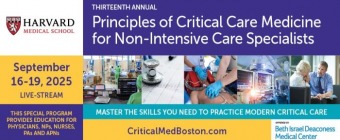
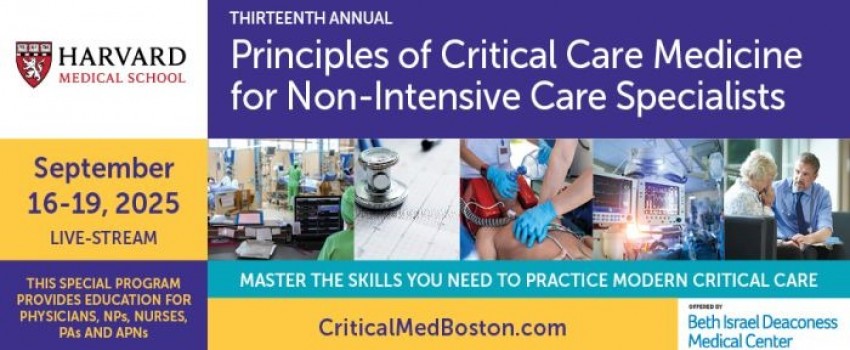
Principles of Critical Care Medicine for Non-Intensive Care Specialists
Master the Skills You Need to Practice Modern Critical Care Medicine
Keeping pace with the rapid changes in evidence-based critical care medicine is difficult for specialty-trained intensivists; for non-intensivists, the challenge of staying up to date can be overwhelming. This cutting-edge CME course is intended to provide core clinical critical-care skills to health care providers who are not trained as intensivists but whose clinical duties involve taking care of critically ill patients.
The focus of this program will be to highlight recent important evidence-based advances in the practice of modern critical care medicine and leave the audience with tangible strategies to immediately improve their practices.
New this year are two intensive training experiences: 1) cardiology critical care and 2) humanizing critical care, both of which will be offered alongside the ventilator troubleshooting module, which remains a staple of the curriculum.
Master the Skills You Need to Practice Modern Critical Care Medicine
Keeping pace with the rapid changes in evidence-based critical care medicine is difficult for specialty-trained intensivists; for non-intensivists, the challenge of staying up to date can be overwhelming. This cutting-edge CME course is intended to provide core clinical critical-care skills to health care providers who are not trained as intensivists but whose clinical duties involve taking care of critically ill patients.
The focus of this program will be to highlight recent important evidence-based advances in the practice of modern critical care medicine and leave the audience with tangible strategies to immediately improve their practices.
New this year are two intensive training experiences: 1) cardiology critical care and 2) humanizing critical care, both of which will be offered alongside the ventilator troubleshooting module, which remains a staple of the curriculum.
A Practical, Comprehensive Update for Busy Clinicians
This program delivers comprehensive updates to improve evaluation, diagnosis and treatment of critically ill patients. Highlights include:
- Principles of mechanical ventilation including ventilator troubleshooting and ventilator liberation
- Updates in the diagnosis and management of cardiogenic shock including best practices for mechanical circulatory support
- Best practices in use of non-invasive ventilation and high-flow nasal cannula
- Updates in management of ARDS including identification of which patients need VV ECMO and when to transfer
- Tangible evidence-based strategies for managing pain, agitation and sedation to minimize harm
- Pearls and pitfalls of using artificial intelligence in the ICU
- Management of submassive and massive PE
- Using POCUS to assess volume responsiveness
- Updates in oncologic, obstetric, neurologic, and infectious disease emergencies
- Physiology of shock and best practices for IV and oral vasopressor use
- Strategies for incorporating palliative care in your ICU
Speakers: Margaret 'Molly' Hayes, MD, ATSF, Morgan I. Soffler, MD, I. Mary Eche, PharmD, BCCCP, FCCM, Dhruv S. Kazi, MD, MSc, MS
Keeping pace with the rapid changes in evidence-based critical care medicine is difficult for specialty-trained intensivists; for non-intensivists, the challenge of staying up to date can be overwhelming. This cutting-edge CME course is intended to provide core clinical critical-care skills to health care providers who are not trained as intensivists but whose clinical duties involve taking care of critically ill patients.
The focus of this program will be to highlight recent important evidence-based advances in the practice of modern critical care medicine and leave the audience with tangible strategies to immediately improve their practices.
New this year are two intensive training experiences: 1) cardiology critical care and 2) humanizing critical care, both of which will be offered alongside the ventilator troubleshooting module, which remains a staple of the curriculum.
Master the Skills You Need to Practice Modern Critical Care Medicine
Keeping pace with the rapid changes in evidence-based critical care medicine is difficult for specialty-trained intensivists; for non-intensivists, the challenge of staying up to date can be overwhelming. This cutting-edge CME course is intended to provide core clinical critical-care skills to health care providers who are not trained as intensivists but whose clinical duties involve taking care of critically ill patients.
The focus of this program will be to highlight recent important evidence-based advances in the practice of modern critical care medicine and leave the audience with tangible strategies to immediately improve their practices.
New this year are two intensive training experiences: 1) cardiology critical care and 2) humanizing critical care, both of which will be offered alongside the ventilator troubleshooting module, which remains a staple of the curriculum.
A Practical, Comprehensive Update for Busy Clinicians
This program delivers comprehensive updates to improve evaluation, diagnosis and treatment of critically ill patients. Highlights include:
- Principles of mechanical ventilation including ventilator troubleshooting and ventilator liberation
- Updates in the diagnosis and management of cardiogenic shock including best practices for mechanical circulatory support
- Best practices in use of non-invasive ventilation and high-flow nasal cannula
- Updates in management of ARDS including identification of which patients need VV ECMO and when to transfer
- Tangible evidence-based strategies for managing pain, agitation and sedation to minimize harm
- Pearls and pitfalls of using artificial intelligence in the ICU
- Management of submassive and massive PE
- Using POCUS to assess volume responsiveness
- Updates in oncologic, obstetric, neurologic, and infectious disease emergencies
- Physiology of shock and best practices for IV and oral vasopressor use
- Strategies for incorporating palliative care in your ICU
Speakers: Margaret 'Molly' Hayes, MD, ATSF, Morgan I. Soffler, MD, I. Mary Eche, PharmD, BCCCP, FCCM, Dhruv S. Kazi, MD, MSc, MS
Entry Fees
Free Registration
Categories
Event Frequency
One Time
Event Timings
(GMT-4:00) Eastern Time (US and Canada)
08:00 AM - 05:00 PM (Sep 16, Sep 17, Sep 18, Sep 19) (Public)
Organizer

Harvard Medical School
0 Followers
Follow
Harvard Medical School is the graduate medical school of Harvard University and is located in the Longwood Medical Area in Boston, Massachusetts. Founded in 1782, HMS is one of the oldest medical schools in the United States.
Comments on Principles of Critical Care Medicine for Non-Intensive Care Specialists
You must Login to write a comment.
Peoples Interested in Visit
0 Peoples Interested to Visit
Featured Event

Please Wait...
Please Wait...
Similar Events


11
Dec
2023
Echo on Marco Island: Case-Based Approach
Collier County, United States
Free
Conferences

29
Jan
2024
Arrhythmias and the Heart: A Cardiovascular Update
Koloa, United States
Free
Conferences

13
Jan
2024
Snowmass Cardiovascular Cases, Controversies, and Challen...
Snowmass Village, United States
Free
Conferences
18
Mar
2024
Heart Failure Management for NP, PA, and Primary Care Pro...
Lake Buena Vista, United States
Free
Conferences

07
Feb
2024
Cardiovascular Conference at Snowbird
Salt Lake County, United States
Free
Conferences


05
Mar
2023
Echo Imaging in Colorado Including Multimodality Imaging:...
Telluride, United States
Free
Conferences